Molecular Modelling and Computer Simulation Group
facebook instagram orcid linkedin youtube


Research Overview

Our research focuses on developing and applying computational chemistry techniques, including first-principles DFT methods, Molecular Dynamics (both equilibrium and non-equilibrium), Quantum Theory of Atoms in Molecules (QTAIM), and Computational Fluid Dynamics[cite: 3, 7]. We apply computer simulations to investigate the structural, dynamic, thermodynamic, and electronic properties of atoms, molecules, liquids, and solids[cite: 3, 7].

Currently, we are focused on studying problems related to clean technology and energy conversion, such as gas capture and separation, lubricants for drilling fluids, and ionic liquid-based polymer electrolytes[cite: 3, 7]. We are also interested in understanding the fundamental thermodynamics of ionic liquids and their mixtures, as well as applying Raman spectroscopy to characterize materials[cite: 3, 7].

DFT and MD applied to Solids and Solid/Liquid Interfaces

DFT and MD applied to Solids
Our group focuses on the computational design and atomistic understanding of materials for sustainability, utilizing periodic Density Functional Theory (DFT) and Molecular Dynamics (MD) simulations to investigate complex problems at solids and solid-liquid interfaces[cite: 4, 7].

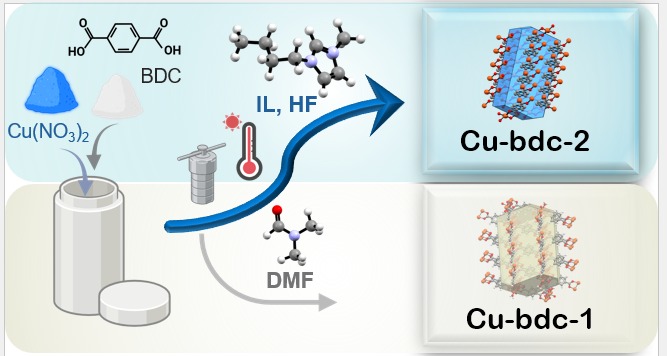
In CO2 capture, we evaluate the influence of metallic centers in Metal-Organic Frameworks (MOFs) like MIL-53 using GGA+U[cite: 4, 7]. For energy storage, we employ MD simulations to model polymer electrolyte/solid-electrode interfaces to characterize ion accumulation and diffusion[cite: 4, 7]. We also extend these methodologies to photoelectrochemical water splitting[cite: 4, 7].
Highlighted Publications
  • Damas G. B. et al. Understanding carbon dioxide capture on metal-organic frameworks... J. Chem. Phys. (2021). DOI[cite: 4, 7]
  • Ebadi M. et al. Modelling the polymer electrolyte/Li-metal interface by molecular dynamics simulations. Electrochim. Acta (2017). DOI[cite: 4, 7]
  • Martins J. S. et al. Ionic liquid induced structural transformation in a copper-based MOF synthesis... J. Chem. Phys. (2021). DOI[cite: 4, 7]

Quantum DFT - Design of Multi-Functional TADF Emitters for OLEDs

TADF Emitters for OLEDs
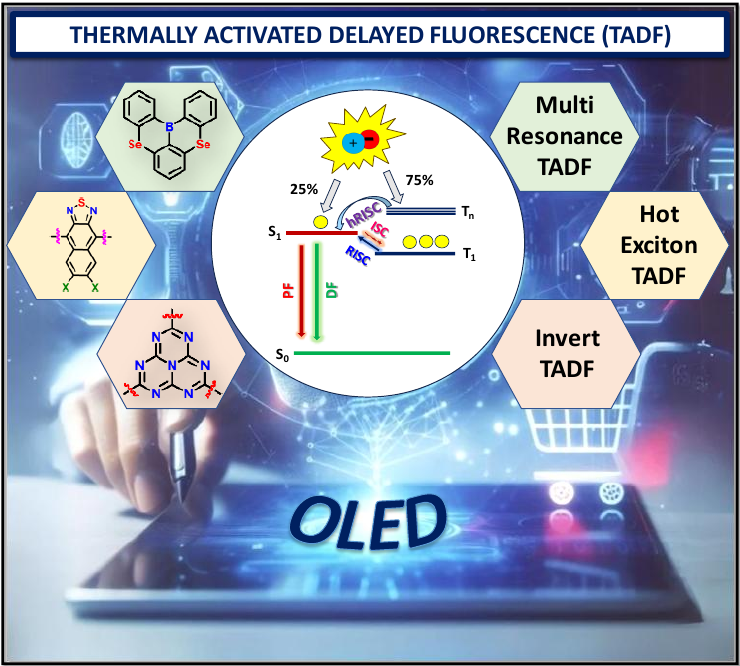
TADF-exhibiting OLED materials are highly promising for applications in flat-panel displays and solid-state lighting sources due to their ability to convert triplet (T1) excitons into singlet (S1) excitons via reverse intersystem crossing (RISC)[cite: 5, 7].

Multifunctional TADF systems expand upon conventional materials by incorporating mechanisms like Multi-Resonant TADF (MR-TADF), Hot-exciton TADF, and Inverted TADF[cite: 5, 7]. We utilize DFT, TDDFT, CCSD, and QM/MM approaches to design and optimize next-generation multifunctional emitters[cite: 5, 7].
Highlighted Publications
  • S. Nathiya. Enhancing Fast RISC in Hot-Exciton Thermally Activated Delayed Fluorescence Emitter... Adv. Theory Simul. (2024). DOI[cite: 5, 7]
  • S. Nathiya. Unravelling the impact of sulfur atom oxidation and donor-acceptor effects on blue TADF emitters... Mol. Syst. Des. Eng. (2024). DOI[cite: 5, 7]
  • S. Nathiya, Panneerselvam M, Luciano T. Costa. A Theoretical Investigation of Heavy Atom and Oxidation Effects in MR-TADF Emitters for OLEDs...[cite: 5, 7]

Artificial Intelligence and Machine Learning: Predicting Material Properties for Energy Storage

AI and Machine Learning for Materials
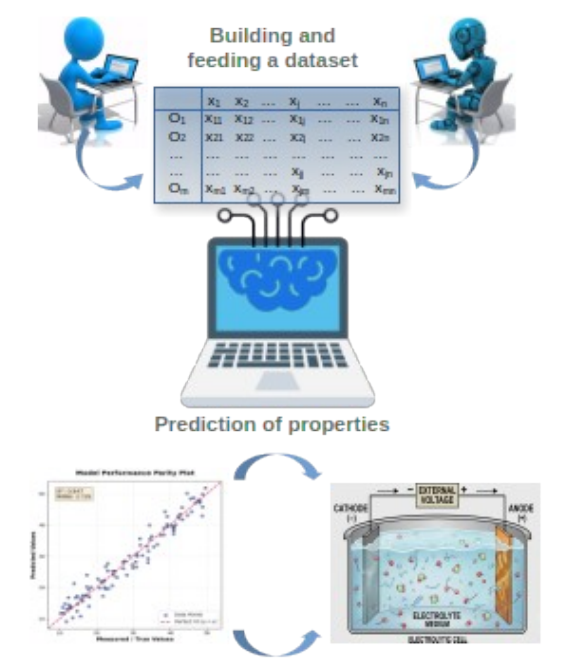
Applying machine learning (ML) and artificial intelligence (AI) techniques accelerates the selection of material components for energy storage applications, drastically reducing the time required for virtual screening[cite: 8].

Our group uses MD, DFT, and ML techniques to build or complement datasets predicting ionic liquid (IL) properties such as viscosity, melting points, and glass transition temperatures for battery electrolytes[cite: 8]. We utilize neural-network-based interatomic potentials for MD with DFT accuracy, alongside Natural Language Processing (NLP) to extract molecular properties directly from literature[cite: 8].
Highlighted Publications
  • De Oliveira, Osmair Vital, et al. Repurposing approved drugs as inhibitors of SARS-CoV-2 S-protein from molecular modeling and virtual screening. J. Biomol. Struct. Dyn. (2021). DOI[cite: 8]

Quantum DFT - Molecular Modelling of Electrocatalysts for HER and CO2RR

Electrocatalysts for HER and CO2RR
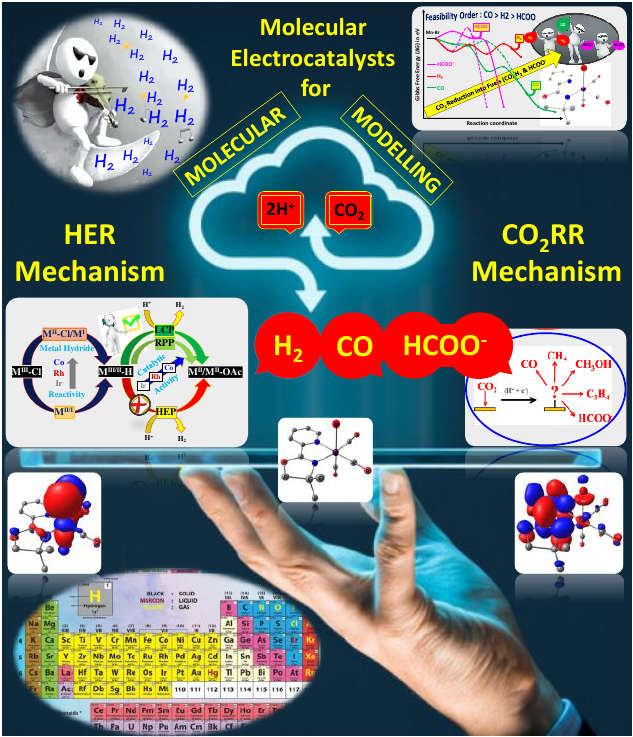
Integrating Density Functional Theory (DFT) into quantum modeling provides profound insights into electronic structures, reaction energetics, and transition states for the Hydrogen Evolution Reaction (HER) and Carbon Dioxide Reduction Reaction (CO2RR)[cite: 9].

We employ Transition State Theory (TST) to map activation barriers and kinetics, alongside NCI-RDG non-covalent analysis, charge density evaluations, and solvent effects[cite: 9]. These simulations bridge theoretical predictions with experimental validation to design sustainable, highly selective electrocatalysts[cite: 9].
Highlighted Publications
  • Panneerselvam, M. et al. Computational Study on the Proton Reduction Potential of Co, Rh, and Ir Molecular Electrocatalysts... ACS Omega (2024). DOI[cite: 9]
  • Panneerselvam, M. et al. Investigating CO2 electro-reduction mechanisms: DFT insight into earth-abundant Mn diimine catalysts... Front. Chem. Sci. Eng. (2024). DOI[cite: 9]
  • Panneerselvam, M. & Jaccob, M. Role of Anation on the Mechanism of Proton Reduction Involving a Pentapyridine Cobalt Complex... Inorg. Chem. (2018). DOI[cite: 9]